
When Peace is a Verb
9/13/25
Saturday, September 21, is International Day of Peace. As Montessorians, we strive for every day to be a day of peace, but this day, set aside by the UN in 1981, gives us an opportunity to reflect on what we are doing to promote peace in our classrooms, schools, communities, and the world.
Next Friday, many classrooms around the world will have some kind of activity to commemorate the occasion. Some will observe a minute of silence at noon in each time zone, resulting in a “peace wave” traveling around the world. Others sing peace around the world by engaging in peace song(s) at 11 AM local time, particularly Light a Candle for Peace, written by MontessorianShelly Murley. Still others will have a school-wide gathering at the peace pole or other place that encourages children and adults to reflect on peace, engaging in some kind of unifying activity. (See https://singpeacearoundtheworld.com/teach-downloads/https://www.youtube.com/watch?v=K9M8SmWh2Fo,https://internationaldayofpeace.org/get-involved/. and others for plentiful ideas on commemorating the day).
These and many other beautiful ceremonies certainly help create an awareness of what we believe in as Montessorians; further, by connecting children with others who are similarly celebrating, children can experience being part of something greater than themselves. What does your school have planned?
Perhaps more importantly, what does your classroom/school do to make peace education more than just a day of commemoration or a unit of study? How do we make peace education an integral part of our pedagogy?
In Peace and Education, Dr. Montessori lamented that, although great resources have been dedicated to the study of war, “there exists no science of peace, no science with an outward development comparable at least with the development of the science of war…” Recently, there has been an overt cultural increase in attention to practices such as reconnecting with nature, meditating, maintaining an attitude of gratitude, living intentionally, and nurturing close friendships as ways to feel more peaceful. Certainly, these mark progress: they were not part of the conversation (back in the dark ages) when I was a child. But I believe that we are called to a higher standard. We are not called to feel peaceful, but to be peace-makers.
There are many Montessori practices that, if we adults institute and promote them, foster authentic peace within the classroom on a day-to-daybasis. Montessorians:
create relationship-centered classroom communities in which children are active decision-makers
follow rules that are founded on respect for self, others, and the environment
share responsibility with the children to care for the classroom (physical environment, social/emotional environment, and behavioral environment)
share responsibility with the children to care for the inhabitants of the environment, both human and other living things
regularly practice gratitude and promote empathy
create an environment (structure) that values collaboration over competition
individualize instruction to meet each child’s needs and abilities
teach children to self-advocate with adults and with other children
practice authentic conflict resolution, not just conflict suppression
include character education through discussion, journaling, and/or literature
promote inclusivity and unity through diversity
include study of great peacemakers AND
dozens of other practices
When these are part of a child’s day-to-day life experience, it shapes a child’s paradigm of what is normal and acceptable. We can hope that, as our children grow into adulthood, this will be so ingrained in them that they will accept nothing less in their own home and work environments.
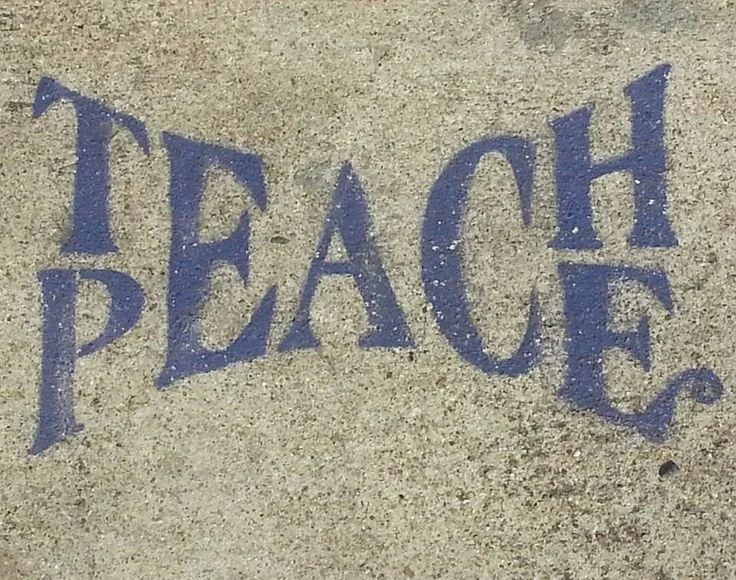
And yet, it occurs to me that these measures, while practiced by everyone in the classroom community, are adult-initiated and, in large part, adult-maintained. As I reflect on our great task of promoting peace through education, it occurs to me that we need to do more than design, implement, and model these practices in our classrooms. We need to equip and empower the children to proactively make peace a part of their everyday lives – to become habitual peacemakers. We need to help them experience peacemaking as an active-voice verb: to peace.
In reflecting on this, I asked myself what it means to me to be a peacemaker. Here is what I came up with:
I have done my best to be my best today. I have done something specific today to promote being in full harmony with myself, with others in my immediate circle, with humankind and/orwith the environment. It matters that I showed up.
I then brainstormed what children might say about what active peacemaking looks like. Here are some ideas (individual acts and group projects), but I bet that if you initiate this conversation with your children, they will have even better ones:
In our classroom
Eat snack or lunch with someone that I don’t usually sit with and find at least a couple of things that we have in common
Helpsomeone in the class who is not already my BFF – someone that I have no expectation will pay back my kindness
IfI have finished what I need to do and am looking for a brain break, I volunteer to help in my own classroom or work with children in a younger classroom
In our school
Show gratitude to someone who is under-appreciated in the school community (janitor or lunch servers or secretary) with a note or a visit - maybe including the gift of coffee… J
Surprisea teacher: help the art or music teacher organize supplies or files, or clean /organize the recess / PE shed
In the community
• Visit a senior center and sing Peace Day songs (also very impactful at a fire station or at a commuter train station during morning rush hour!)
Plant trees or pollinating plants
Beautify the school yard or park in the neighborhood
At home
Dosomething helpful without being asked
Letmy sibling win an argument (maybe just one)
Sharesomething I love with another family member
Askto walk or ride bikes somewhere to avoid using the car
Makedinner / pack lunches for the next day
Advocatefor my family to give up some single-use plastics (plastic bags and water bottles are a great place to start)
In the broader worldview context
Organize a food drive or volunteer at a food bank or shelter
Organized a gently-used and new toy drive for a shelter that accepts children
Knit lap blankets for seniors or for first responders to keep on hand for people having a hard day
Makegrocery bags from donated fabric and give them away
Fundraise for a charity
As is always the case, shining the spotlight on something will have a temporary effect. After a conversation like this, there will be an uptick in random and planned acts of kindness. The trick is causing the practice to continue until it becomes a habit, part of the culture. I know one teacher who brought an empty, large, purified water jug into the classroom. The opening of the jug was big enough to allow a ping-pong ball to fit through the top. Each time a community member completed an act of kindness/act of peacemaking, he/she put a ping-pong ball into the jug. This could be done covertly or at line time, with the person sharing the act that they did in an effort to recruit/inspire others to do the same. Periodically, someone would comment on how peace was growing because of the members of the community, a source of pride for the children and adults alike. Note: if you choose to do something like this, please avoid the temptation to celebrate in some way when the jug is full. That changes the focus from the process to the product, and may result in children slipping in ping-pong balls when they actually have done nothing of significance. When the jug is full, simply empty it and start again or start a second jug!
Of course, the side benefit of all of this is that committing these acts of peace helps children see that even at the ripe old age of 9 (+/-) they can make a difference. This raises their self-esteem and makes it more likely that they will act in a positive, proactive manner again, and may also help children become more normalized in the classroom and in life.
Reflection for Adults: What is already planned for International Day of Peace at the school-wide level? What traditions are there in my own classroom for commemorating the day?
What classroom leadership/classroom management practices do the adults in my room already have in play that foster authentic peace within the classroom on a day-to-day basis? Are there any that I would like to add?
Is there something that I would like to do this year to take our celebration of International Day of Peace from a commemoration to an activity that actively promotes the well-being of others, promoting peace?
Reflection for Children: What is my habit when I want to do something with intention, when I want to calm myself and center myself? What really helps me get “in the zone”? This might be something I do at the end of recess each day or at the beginning of the work cycle. It might be something I do when I know that I have been feeling out of sorts and want to break that mood. Or it might be something I do just before starting something I care about that will need my focus, like just before starting to play an important game.
What do I do when I feel like I need some peace? This might be the same answer or a different one. It might involve a special location or a special ritual or words that help me find peace.
When have I brought peace to others – been a peacemaker – in my classroom, school, community, at home or in the world? How did I feel after that?
“Preventing conflicts is the work of politics; establishing peace is the work of education.”
-MM 1936 European Congress for Peace in Brussels